Total Pageviews
Tuesday, 11 December 2012
Cooperative Cuba
The new law on Cooperatives was approved today. Some 200 types of enterprise will now be open to be run by workers' cooperatives. The UK's Financial Times story is HERE.
“This opens the door to exciting social innovations, potentially creating a large sector of the economy that would be neither entirely capitalist nor state-socialist but uniquely Cuban – grassroots, democratic, and productive.” Hear, Hear!
Sunday, 9 December 2012
Border disputes
Cuba's new migration rules come into force in the New Year and the consequence will be to put the ball well and truly into Washington's court to do something about the US's ridiculous policy towards migrants from Cuba.
Into this breach steps the right-wing think-tank the Lexington Institute this week with a new report from Philip Peters, its vice-president, and someone who knows Cuba as well as anyone inside the beltway. He is full square behind a overhaul of the current policy and argues why cogently and comprehensively. You can read the full paper HERE. His conclusions are below:
• Repeal the Cuban Adjustment Act. The special
circumstances that gave rise to the Act in 1966
have long ago ceased to exist. Absent those circumstances,
there is no reason to give special immigration
privileges to immigrants from Cuba whose
motives are mainly economic. Repeal of the Act
would end the practice of effectively condoning
illegal immigration through the “dry foot” policy,
and it would undermine the business of alien
smuggling from Cuba.
• Repeal the special provisions in the Refugee Assistance
Act that provide refugee public assistance
benefits to immigrants from Cuba who are not
refugees. This will ensure that benefits intended
for refugees are not extended to Cuban immigrants
generally, who do not have refugee status. This
will end an abuse of the U.S. taxpayer and an inappropriate
use of the refugee resettlement program.
• Retain the policy of admitting 20,000 Cubans
annually as immigrants, pursuant to the migration
accords. This practice, combined with the return
of migrants intercepted at sea, has coincided with
a long period in which no mass migration events
have occurred.
• Retain refugee processing at the U.S. Interests Section
in Havana.
• Continue the family reunification parole program.
This program has proven vital to reaching the figure
of 20,000 immigrants per year. Since it connects
Cuban immigrants with family members in the
United States, those immigrants are less likely to
require public assistance.
Thursday, 6 December 2012
Cuba accuses US of Gross fabrication
The BBC's Sarah Rainsford reports today that Cuba is accusing the US
of lying about the health and detention conditions of Alan Gross the American
jailed in Havana for smuggling in illegal internet equipment and trying to subvert the state.
The US State Department this week marked the third
anniversary of Alan Gross's sentencing by calling his 15-year sentence
unjustified.It said Mr Gross had lost more than 40kg (100 lb) and called for him to be seen by a doctor of his own choosing.
The Cuban foreign ministry denied Mr Gross was getting inadequate care.
Spokeswoman Josefina Vidal said a biopsy on a mass that had appeared on his shoulder showed he did not have cancer, as his family had feared. She added that there was no need for an independent doctor's report.
Monday, 3 December 2012
Gross calls for pact with Cuba
![]() |
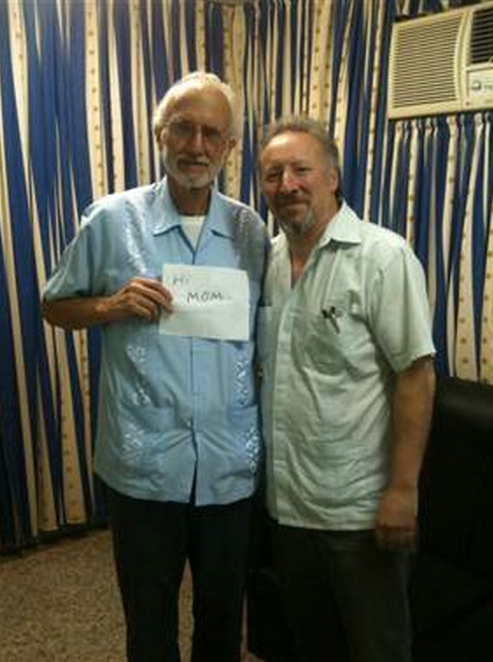
| Peter Kornbluh's iPhone photo. Credit: NBC News |
The National Committee to Free the Cuban Five asks supporters to contact their senators and press for a prisoner swap (see contact information here).
Tracey also notes that NBC News on Sunday reported that Cuba specialist Peter Kornbluh had met with Gross for four hours on Nov. 28.
Kornbluh works at the National Security Archives, a respected nonprofit group that over the past 25 years has filed 40,000 Freedom of Information and declassification requests with more than 200 federal offices and agencies, opening up more than 10 million pages of previously secret government documents.
Kornbluh told NBC News that Gross was upset that the U.S. government has not done more to seek his release.
He’s angry, he’s frustrated, he’s dejected — and he wants his own government to step up" and negotiate, Kornbluh said. "His message is that the United States and Cuba have to sit down and have a dialogue without preconditions. … He told me that the first meeting should result in a non-belligerency pact being signed between the United States and Cuba.
Saturday, 1 December 2012
Mr Gross's misconduct - all 'flawed' and 'messed up'
The New York Times has reported on the story of Alan Gross, the USAID contractor who was jailed in Cuba accused of espionage. He is now suing his employers and the USAID department for damages becasue he alleges they put him in harm's way for sending him to Cuba badly prepared for the risks he was taking.
The facts of the case as they are now emerging begin to prove what the Cuban government has been saying all along. Mr. Gross, whether he knew it or not, was part of a systematic programme to undermine the Cuban government that was conceived and financed by the US government. In other words he was a foriegn agent trying to overthrow the Cuban state. That's illegal espionage in anyone's books. Here is the NYTimes on the case:
Scott Gilbert, one of the Gross
family’s lawyers, said the case could be especially damaging for the State
Department and DAI if the discovery process produces more examples of
unqualified and ill-prepared contractors sent to Cuba. He said the suit would
draw attention to the American government’s pro-democracy effort, which Mr.
Gilbert described as “flawed in conception” and “completely messed up” in
execution.
You can read the main parts of the suit here
(pdf).
Note carefully the following:
· The USAID
programme Gross was working on derives from the so-called Helms-Burton Law of 1996 and is geared toward changing the
political order in Cuba. (p.9)
· From page 20, it details Gross’
trips to Cuba, noting that in each instance he came home, he warned his
employer (DAI, a USAID contractor based in Maryland) about the risks in his activity,
those warnings were ignored and he was often urged by DAI to get on with the
programme, he returned to Cuba, and DAI continued making money from the programme.
My fellow blogger Phil Peters of the Lexington Institute comments:
"Of course Mr. Gross was making plenty of money too, and it
sort of jumps off the page that the lawsuit assigns responsibility to everyone
but Mr. Gross for the trips that he himself made to Cuba, even after perceiving
the dangers. It should also be noted
that while Mr. Gross was issuing his warnings, he also continued his modus operandi of traveling to Cuba
along with American Jewish delegations and having unwitting members of those
delegations carry some of his equipment.
Not a nice guy."
There's more background on the Cuban
case against Mr. Gross; on the US government’s handling of the case (here
and here)
and everything that Phil Peters has ever posted on the case here.
Saturday, 24 November 2012
Havana schools of art still cause outrage
Rowan Moore reports in today's Observer newspaper that the great ballet dancer Carlos Acosta wants to give something back both to his art form and to Cuba, and has offered his own money and the fundraising power of his energy and his name, to create a new centre for dance and culture on the edge of Havana. In the process, he hopes to give a new future to one of the most remarkable buildings of the 20th century, in Cuba or anywhere else. The eminent Lord Foster has helped him with a feasibility study, free of charge, yet the plan has provoked uproar, says Rowan.
The building in question is the School of Ballet, a work of the heady early years of the Cuban revolution, and Cuban architects are questioning whether a powerful international practice, Foster's, will best reflect its spirit. The school's original architect, Vittorio Garatti, has written to Fidel Castro in protest. The reason is that Foster is a modernist - a movement which the original architect rejected.
The current debate, says Rowan, is the latest episode in a story so dramatic and colourful it could inspire a book, a feature film or an opera. As, indeed, it has – all three. The ballet school is part of a complex called the National Schools of Art, about which architect and educator John Loomis has written a book, Revolution of Forms, which has been made into a movie (called Unfinished Spaces) now doing the rounds of film festivals, and is the basis of an opera directed by Robert Wilson. Watch the trailer above
Thursday, 22 November 2012
EU ice is melting?
| Cuban Cartoon: "Clearly my love, I know that you like my position, but everyone is commenting that the only thing that I have in common with anypone is with you" |
Spain’s Deputy Foreign Minister, Gonzalo de Benito, said:“Starting now, what the [European] Commission is going to do is to establish some guidelines so that this cooperation accord may be negotiated, representing a step forward in the relationship between the European Union and Cuba,”
The EU sees the recent chnages in Cuba as “a positive evolution”, he added.
This is welcome news and means that some form of EU-Cuba association agreement might eventually be agreed. Cuba is the only country in Latin America that the EU has no formal relationship with.
The EU has previously argued that its unilateral ‘Common Position’ “encourages dialogue with the Cuban authorities to promote respect for human rights, progress towards pluralist democracy and economic reforms”. However, officials and some Member States believe that this policy has been a failure and that there is a need to begin to put in place the possibility of bilateral agreement.
Subscribe to:
Posts (Atom)