Total Pageviews

Saturday, 15 December 2012

Could Delta open the floodgates?


Speculation is rife that the Obama administration is about to relax travel restictions to Cuba further following the announcement that the US carrier Delta Airlines is close to buying a share of Richard Branson's Virgin Atlantic.
Today's UK Independent newspaper reports that Virgin Atlantic is currently 49 per cent owned by Singapore Airlines. Delta, the world’s biggest carrier, is bidding for that stake. If almost half the airline becomes US-owned, Virgin has said that it will still continue with its thrice-weekly jumbo from Gatwick to Cuba.
A spokeswoman for Virgin Atlantic is quoted as saying: “We have no plans to cancel flying to Havana”.
At Delta’s Atlanta headquarters, the planned minority ownership of an airline serving Cuba is not regarded as an issue according to a spokesman. The confidence that the Virgin’s Havana connection will continue has led to the speculation that the Obama administration is preparing to ease the long-standing embargo.
Mmmmmmm.... let's see.

Wednesday, 12 December 2012

Don't believe the BBC, go and see it for yourself


I was once fortunate enough to be assigned a press visa to visit Cuba on behalf of a British newspaper (I shall spare its blushes by not naming it) and attended not a few press conferences. At one, I was surprised by the less than well-informed and rather aggressive questioning from a representative of a well-known UK institution. I was more surprised by the fact that, knowing the kind of reports the unnamed correspondent filed, this individual was still being given visas to enter the island let alone a press pass. I happened to be standing beside the then head of Havana's press centre, which is an arm of the Foreign Ministry in charge of granting visas. I said to him: "Why on earth do you tolerate this guy? Have you seen the sort of disinformation he publishes? Why don't you tell him to stop lying about you, or else?" The Press chief looked at me wryly and replied: "What was it your dear Oscar Wilde said, Steve? There's only one thing worse than being talked about... and that's not being talked about? He writes a lot of rubbish but at least we are in there. Do you know how many times Brazil or Argentina are mentioned in his publication? You wouldn't know they exist!"
I relate this anecdote because yesterday evening I saw a documentary on the BBC about Cuba by a young man called Simon Reeves. (Pictured). Frankly, it was littered with so many of the most ridiculous errors of fact and sweeping generalisations that those who know Cuba well would find it hard to stomach. Nonetheless, like the Cuban press chief, I am heartened by the fact that it was aired by the BBC and by the simple observation that no matter how badly Mr Reeves tried to paint Cuba's economy, the shining, irrepressible smiles of the Cubans he talked to shone through. He did not find a single unhappy face and the photography was supurb. Despite the gloating way he suggested that capitalism was returning to Cuba, he nonetheless presented a place that many who watched would like to visit. Don't take Simon Reeves' word for it, go and see it for yourself.

Tuesday, 11 December 2012

Cooperative Cuba


The new law on Cooperatives was approved today. Some 200 types of enterprise will now be open to be run by workers' cooperatives. The UK's Financial Times story is HERE.

Richard Fineberg, a non-resident senior fellow of the Washington-based Brookings Institution and author of its recently released report: 'The New Cuban Economy: What Roles for Foreign Investment?' says:
“This opens the door to exciting social innovations, potentially creating a large sector of the economy that would be neither entirely capitalist nor state-socialist but uniquely Cuban – grassroots, democratic, and productive.” Hear, Hear!

Sunday, 9 December 2012

Border disputes


Cuba's new migration rules come into force in the New Year and the consequence will be to put the ball well and truly into Washington's court to do something about the US's ridiculous policy towards migrants from Cuba.

Into this breach steps the right-wing think-tank the Lexington Institute this week with a new report from Philip Peters, its vice-president, and someone who knows Cuba as well as anyone inside the beltway. He is full square behind a overhaul of the current policy and argues why cogently and comprehensively. You can read the full paper HERE. His conclusions are below:

• Repeal the Cuban Adjustment Act. The special
circumstances that gave rise to the Act in 1966
have long ago ceased to exist. Absent those circumstances,
there is no reason to give special immigration
privileges to immigrants from Cuba whose
motives are mainly economic. Repeal of the Act
would end the practice of effectively condoning
illegal immigration through the “dry foot” policy,
and it would undermine the business of alien
smuggling from Cuba.

• Repeal the special provisions in the Refugee Assistance
Act that provide refugee public assistance
benefits to immigrants from Cuba who are not
refugees. This will ensure that benefits intended
for refugees are not extended to Cuban immigrants
generally, who do not have refugee status. This
will end an abuse of the U.S. taxpayer and an inappropriate
use of the refugee resettlement program.

• Retain the policy of admitting 20,000 Cubans
annually as immigrants, pursuant to the migration
accords. This practice, combined with the return
of migrants intercepted at sea, has coincided with
a long period in which no mass migration events
have occurred.

• Retain refugee processing at the U.S. Interests Section
in Havana.

• Continue the family reunification parole program.
This program has proven vital to reaching the figure
of 20,000 immigrants per year. Since it connects
Cuban immigrants with family members in the
United States, those immigrants are less likely to
require public assistance.

Thursday, 6 December 2012

Cuba accuses US of Gross fabrication


The BBC's Sarah Rainsford reports today that Cuba is accusing the US of lying about the health and detention conditions of Alan Gross the American jailed in Havana for smuggling in illegal internet equipment and trying to subvert the state.
The US State Department this week marked the third anniversary of Alan Gross's sentencing by calling his 15-year sentence unjustified.
It said Mr Gross had lost more than 40kg (100 lb) and called for him to be seen by a doctor of his own choosing.
The Cuban foreign ministry denied Mr Gross was getting inadequate care.
Spokeswoman Josefina Vidal said a biopsy on a mass that had appeared on his shoulder showed he did not have cancer, as his family had feared. She added that there was no need for an independent doctor's report.

Monday, 3 December 2012

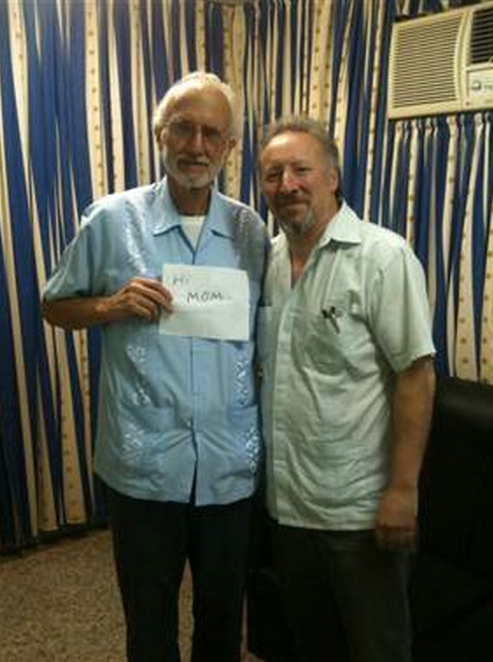
Gross calls for pact with Cuba

Peter Kornbluh's iPhone photo. Credit: NBC News
I read today, on the third anniversary of the jailing of Alan Gross in Cuba, a blog by my colleague Tracey Eaton, that the US Senate is to present a resolution calling for his release.

The National Committee to Free the Cuban Five asks supporters to contact their senators and press for a prisoner swap (see contact information here).

Tracey also notes that NBC News on Sunday reported that Cuba specialist Peter Kornbluh had met with Gross for four hours on Nov. 28.

Kornbluh works at the National Security Archives, a respected nonprofit group that over the past 25 years has filed 40,000 Freedom of Information and declassification requests with more than 200 federal offices and agencies, opening up more than 10 million pages of previously secret government documents.
Kornbluh told NBC News that Gross was upset that the U.S. government has not done more to seek his release.

He’s angry, he’s frustrated, he’s dejected — and he wants his own government to step up" and negotiate, Kornbluh said. "His message is that the United States and Cuba have to sit down and have a dialogue without preconditions. … He told me that the first meeting should result in a non-belligerency pact being signed between the United States and Cuba.

Saturday, 1 December 2012

Mr Gross's misconduct - all 'flawed' and 'messed up'


The New York Times has reported on the story of Alan Gross, the USAID contractor who was jailed in Cuba accused of espionage. He is now suing his employers and the USAID department for damages becasue he alleges they put him in harm's way for sending him to Cuba badly prepared for the risks he was taking.

The facts of the case as they are now emerging begin to prove what the Cuban government has been saying all along. Mr. Gross, whether he knew it or not, was part of a systematic programme to undermine the Cuban government that was conceived and financed by the US government. In other words he was a foriegn agent trying to overthrow the Cuban state. That's illegal espionage in anyone's books. Here is the NYTimes on the case:

Scott Gilbert, one of the Gross family’s lawyers, said the case could be especially damaging for the State Department and DAI if the discovery process produces more examples of unqualified and ill-prepared contractors sent to Cuba. He said the suit would draw attention to the American government’s pro-democracy effort, which Mr. Gilbert described as “flawed in conception” and “completely messed up” in execution.
You can read the main parts of the suit here (pdf).   
Note carefully the following:
·          The USAID programme Gross was working on derives from the so-called Helms-Burton Law of 1996 and is geared toward changing the political order in Cuba. (p.9)
·         From page 20, it details Gross’ trips to Cuba, noting that in each instance he came home, he warned his employer (DAI, a USAID contractor based in Maryland) about the risks in his activity, those warnings were ignored and he was often urged by DAI to get on with the programme, he returned to Cuba, and DAI continued making money from the programme.

My fellow blogger Phil Peters of the Lexington Institute comments: 
"Of course Mr. Gross was making plenty of money too, and it sort of jumps off the page that the lawsuit assigns responsibility to everyone but Mr. Gross for the trips that he himself made to Cuba, even after perceiving the dangers.  It should also be noted that while Mr. Gross was issuing his warnings, he also continued his modus operandi of traveling to Cuba along with American Jewish delegations and having unwitting members of those delegations carry some of his equipment.  Not a nice guy."
There's more background on the Cuban case against Mr. Gross; on the US government’s handling of the case (here and here) and everything that Phil Peters has ever posted on the case here.