Total Pageviews
Thursday, 3 January 2013
Obama to ease embargo? Don't bank on it
Ideas that President Obama has eased the embargo on Cuba are wide of the mark. Although he has relaxed some travel restrictions to the island, in fact the Obama first term saw an increase of financial pressure on Cuba, not a lessening.
This has been most marked in the avid application of fines on foreign banks who do business on the island.
Pressed by Washington, recently Switzerland’s fourth-largest bank dropped its business with Cuba, Swiss media has reported.
Zürcher Kantonalbank (ZKB), which is state-owned, had picked up a Cuba portfolio after Swiss banking giants UBS and Crédit Suisse canceled their business with the island seven and five years ago, respectively.
The Obama Administration has increased the financial pressure on Cuba, partly as a side effect of a crackdown on Iran and drug-related money laue Treasndering. Thury Department’s Office of Foreign Assets Control (OFAC) recently issued a record fine of $1.9 billion to Britain’s HSBC over alleged money laundering in Mexico and violations of the U.S. embargo.
ZKB “cannot avoid paying attention to embargoes and blacklists,” a bank spokesman told finance newsletter Inside Paradeplatz. “After prominent competitors bid farewell to the Cuba business long ago, due to the U.S. embargo, Zürcher Kantonalbank is now pulling out of Cuba for the same reason.”
The Kantonalbank move happened just as the U.S. government is investigating the role of Switzerland’s largest banks in tax evasion by U.S. citizens.
UBS in 2004 paid the United States a fine of $140 million, after the bank had swapped old dollar bills for new ones for Cuba-related customers.
Biggest fines of the banking world since 2009
1. $1.9 billion, HSBC, December 2012. Charge: Accused of money laundering activities tied to drug cartels in Mexico, terror-linked groups in Saudi Arabia.
2. $667 million, Standard Chartered, August and December 2012. Charge: Violating U.S. sanctions on transactions with Iran, Burma, Libya and Sudan.
3. $619 million, ING Bank NV, June 2012. Charge: Covering up fund transfers in violation of U.S. sanctions against Cuba, Iran.
4. $536 million, Credit Suisse, December 2009. Charge: Allowing clients in Iran, Libya, Sudan, Myanmar and Cuba to conduct financial transactions.
5. $470 million, Barclays, November 2012. Charge: Rigging electricity market.
6. $450 million, Barclays, June 2012. Charge: Manipulating bank Libor rates.
7. $350 million, Lloyds TSB Group. Charge: Allowing Iranian and Sudanese clients access to the U.S. banking system.
8. $335 million, Bank of America, December 2011. Charge: Racial discrimination in lending rates.
9. $298 million, Barclays, August 2010. Charge: Allowing client payments from Cuba, Sudan.
10. $275 million, JPMorgan Chase, February 2012. Charge: Problems in mortgage servicing business.
11. $233 million, Royal Bank of Scotland, June 2012. Charge: Manipulating bank Libor rates.
12. $207 million, Ally Financial, February 2012. Charge: Problems in mortgage servicing business.
Friday, 28 December 2012
Europe is to start talking with Cuba, but will it DO anything?
The European Union is preparing to start talking soon to Cuba about a new relationship,but it will take one and a half years to arrive at an agreement, according to this report in the Havana Times. While talks go on the EU's Common Position on Cuba will remain in force. This 'position' which critics say is neither a position or common, is what prevents Brussels from engaging positively with Cuba and was adopted in 1996 following the passage of the Helms Burton Act in the United States. It ties increased cooperation with Cuba to 'improvements in human rights' and states that the objective of the EU is to encourage a 'pluralist democracy' in Cuba. Both ideas are anathema to the government in Havana who see this as illegal interference in their internal affairs.
Consequently, in Cuba, as the cartoon above illustrates, the Common Position is seen as having been dictated to the EU by Washington, an assumption for which there is ample evidence given that Spanish PM Jose Maria Aznar was reported by the newspaper El Pais to have received instructions from a US envoy to introduce the measures back in 1996.
Given the huge steps being taken in Cuba to introduce the market into domestic production and exchange, with the plan to have 35 per cent of the workforce in the private sector by 2015, one would have thought that the EU would wish to change its policy more quickly in order to encourage Cuba along the path towards a free market and 'pluralist democracy'.
Such a change is long overdue. Indeed, it is because of the Common Position, that Cuba is the only country in the Americas, from Canada to Argentina, with which the European Union does not have a bilateral commercial agreement. However, according to reports by Amnesty International, Cuba is far from being the worst one in the hemisphere in terms of violations of fundamental human rights. The Common Position is also ineffective because it has not had any influence on the decisions taken by Havana and has led to a freeze in bilateral relations. Finally, it is shamefully hypocritical because many countries in the EU- particularly those who oppose normalization with Cuba such as Poland, the Czech Republic, Hungary and, yes, the good old UK- have, according to Amnesty International, a human rights situation that is worse than Cuba.
Someone once said that there were three reasons to change a policy: if it was illegal, if it was immoral and if it didn't work. The Common Position seems to fit all three.
Saturday, 22 December 2012
Kerry sets hearts fluttering in Miami
The appointment of Massachussetts' Senator John Kerry as Secretary of State to replace Hilary Clinton, has set hearts fluttering in Miami because of fears this might induce a further relaxation of the travel restrictions on Americans visiting Cuba. Kerry is a long time supporter of unrestricted travel, including tourist travel, to the island.
He supported the 2009 Freedom to Travel Bill and, as Senate Foreign Relations Committee Chairman, as recently as 2011 he released the following statement:
"Cuba remains, regrettably, the only country in the world that the United States government does not allow its citizens to travel to freely. I intend to continue pushing legislation, such as I sponsored in the last Congress, that will allow free travel to Cuba. After 50 years of embargo against Cuba and government prohibitions on contact, it’s time to try something different.”
Hopes that his appointment to high office will see him using it to bring about his stated intentions should be tempered by the long-established tradition of politicians finding that the pressures of office prevent them from being able to make good on the rhetorical promises they made before obtaining power. In addition, one should note that Senator Kerry is extremely vulnerable to attack from the right.
He is a man the US right love to hate because he is by US standards so liberal that they accuse him of being a socialist. Kerry's experience in the Vietnam War led him to empathise with those who saw the US government's role there as dishonourable. A former lawyer and state prosecutor, Kerry is a man of high ideals and has an audacious temperament. In the past his audacity has cost him dearly.
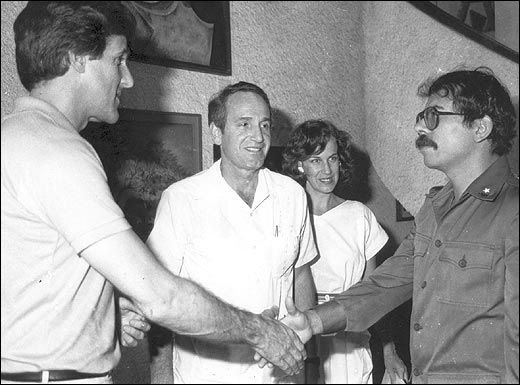
For example, within weeks of taking office as a Senator in 1985 he went to Nicaragua, then governed by the Sandinsitas in the full flush of their revolutioanry fervour. He was accompanied by reporters on a 36-hour, self-appointed fact-finding mission with another newly-elected Democratic Senator, Tom Harkin of Iowa. Congressional Democrats had accused the White House of exaggerating the "communist threat" posed by the Sandinistas. So the two senators were publicly castigated when - just days after meeting with Daniel Ortega and other Nicraguan leaders - the Sandinistas climbed aboard a plane to Moscow to cement ties with the Soviet Union. Then Secretary of State George Shultz declared that Kerry and Harkin had been "used" by the Nicaraguans, and he ridiculed them for their naivete in "dealing with the communists." Kerry was called "silly" in the Boston press.
The photograph of Kerry (above) shaking hands with Sandinista leader Daniel Ortega is to be found on a thousand far right blogs and websites across the US. (Nicaragua, now once again under Ortega, is of course a close ally of Cuba and Ortega is a close personal friend of Fidel Castro).
Will Kerry and Obama be able to face down the cries of "soft on Castro" in order to bring about the feared and hoped for changes to US policy on the island? Post-Newtown, with the President taking on the gun lobby and facing the political minefield that entails, I would not bet on it.
Wednesday, 19 December 2012
Recognition - rightly earned, richly deserved and correctly judged
I have the honour to have been one of the first in the world, and almost definitely the first in the English speaking world, to have recognised the talent of Leonardo Padura Fuentes, who has just been awarded the Cuban National Prize for literature, the highest award that an author in Cuba can win.
When I heard the news today I was very emotional - not merely because I can count Leonardo as my friend and feel happy for him, but also because the recognition, by Cuba's Book Institute and the Ministry of Culture, means so very much. Leonardo is the rarest of authors. He has the ability to know his audience so well that his prose seems to speak to each of them individually. His work is also controversial, and he has done so much to open up the space for creativity and freedom of expression for artists in Cuba that this prize is a victory of huge dimensions and will have enormous repurcusions. I recall that when I first read his work in 1991, I was amazed and said to myself then that this man would either win the national prize or be expelled for his courage and his talent. I am so happy for him (and the country) that he has won. I explain why I felt this way in my book, which, if you will excuse my self-promotion can be reviewed HERE.
Saturday, 15 December 2012
Could Delta open the floodgates?
Speculation is rife that the Obama administration is about to relax travel restictions to Cuba further following the announcement that the US carrier Delta Airlines is close to buying a share of Richard Branson's Virgin Atlantic.
Today's UK Independent newspaper reports that Virgin Atlantic is currently 49 per cent owned by Singapore Airlines. Delta, the world’s biggest carrier, is bidding for that stake. If almost half the airline becomes US-owned, Virgin has said that it will still continue with its thrice-weekly jumbo from Gatwick to Cuba.
A spokeswoman for Virgin Atlantic is quoted as saying: “We have no plans to cancel flying to Havana”.
At Delta’s Atlanta headquarters, the planned minority ownership of an airline serving Cuba is not regarded as an issue according to a spokesman. The confidence that the Virgin’s Havana connection will continue has led to the speculation that the Obama administration is preparing to ease the long-standing embargo.
Mmmmmmm.... let's see.
Wednesday, 12 December 2012
Don't believe the BBC, go and see it for yourself
I was once fortunate enough to be assigned a press visa to visit Cuba on behalf of a British newspaper (I shall spare its blushes by not naming it) and attended not a few press conferences. At one, I was surprised by the less than well-informed and rather aggressive questioning from a representative of a well-known UK institution. I was more surprised by the fact that, knowing the kind of reports the unnamed correspondent filed, this individual was still being given visas to enter the island let alone a press pass. I happened to be standing beside the then head of Havana's press centre, which is an arm of the Foreign Ministry in charge of granting visas. I said to him: "Why on earth do you tolerate this guy? Have you seen the sort of disinformation he publishes? Why don't you tell him to stop lying about you, or else?" The Press chief looked at me wryly and replied: "What was it your dear Oscar Wilde said, Steve? There's only one thing worse than being talked about... and that's not being talked about? He writes a lot of rubbish but at least we are in there. Do you know how many times Brazil or Argentina are mentioned in his publication? You wouldn't know they exist!"
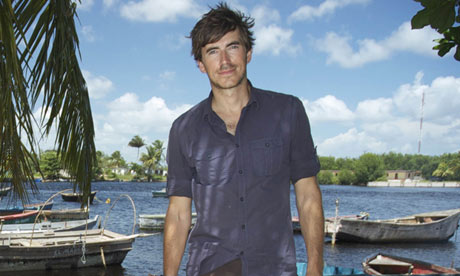
I relate this anecdote because yesterday evening I saw a documentary on the BBC about Cuba by a young man called Simon Reeves. (Pictured). Frankly, it was littered with so many of the most ridiculous errors of fact and sweeping generalisations that those who know Cuba well would find it hard to stomach. Nonetheless, like the Cuban press chief, I am heartened by the fact that it was aired by the BBC and by the simple observation that no matter how badly Mr Reeves tried to paint Cuba's economy, the shining, irrepressible smiles of the Cubans he talked to shone through. He did not find a single unhappy face and the photography was supurb. Despite the gloating way he suggested that capitalism was returning to Cuba, he nonetheless presented a place that many who watched would like to visit. Don't take Simon Reeves' word for it, go and see it for yourself.
Tuesday, 11 December 2012
Cooperative Cuba
The new law on Cooperatives was approved today. Some 200 types of enterprise will now be open to be run by workers' cooperatives. The UK's Financial Times story is HERE.
Richard Fineberg, a non-resident senior fellow of the
Washington-based Brookings Institution and author of its recently
released report: 'The New Cuban Economy: What Roles for Foreign
Investment?' says:
“This opens the door to exciting social innovations, potentially
creating a large sector of the economy that would be neither entirely
capitalist nor state-socialist but uniquely Cuban – grassroots,
democratic, and productive.” Hear, Hear!
Subscribe to:
Posts (Atom)