Total Pageviews

Friday, 4 April 2014

Public event: The Cuban ‘update’ and US-Cuba relations

Public event: The Cuban ‘update’ and US-Cuba relations


Join Professor Raúl Rodríguez Rodríguez for a seminar on the current state of the Cuban ‘updating’ or reform process and how this may affect Cuba- US Relations.

6.30pm
Thursday 8th May 2014,
Lecture Theatre on the lower ground floor.
(Institute of Advanced Legal Studies, 17 Russell Square, London WC1B 5DR)

Attendance is FREE but please register in advance with Olga Jiménez:


Professor Rodríguez Rodríguez is a professor/researcher and currently Deputy Director of   the Center for Hemispheric and United States Studies at the University of Havana.

This event is organised by the International Institute for the Study of Cuba and the Institute of Latin American Studies, University of London.

Sunday, 23 February 2014

Book Launch and signing: The Man Who Loved Dogs

Public Event 

In Conversation: Leonardo Padura Fuentes


 6.30pm. Wednesday 19th March,
The Council Chamber, 
Institute of Advanced Legal Studies,
17 Russell Square, 
London WC1B 5DR


Join the celebrated Cuban author Leonardo Padura Fuentes and his UK publisher Bitter Lemon Press for an evening of conversation about his latest book in translation, The Man Who Loved Dogs.
Leonardo is in London as part of a world tour. Already Cuba’s most acclaimed author in the hispanophone world, with the publication in English of this epic historical novel about the death of Russian Revolutionary Leon Trotsky, Leonardo is poised to become equally recognised in the UK and the US.
This evening Leonardo will be discussing his life and work and the current situation in Cuba with Dr Stephen Wilkinson, Editor of the International Journal of Cuban Studies and author of Detective Fiction in Cuban Society and Culture (Peter Lang 2006) which analyses Leonardo’s early detective stories, also published in translation by Bitter Lemon Press.
A wine reception will follow the event and there will be an opportunity to purchase signed copies of the works discussed.
The event is sponsored by the International Institute for the Study of Cuba, The Institute of Latin American Studies and Bitter Lemon Press.

Entry is FREE but please register in advance by email to Olga Jiménez:

Saturday, 8 February 2014

What it is all about with Alfy


Would you buy a second-hand sugar estate from these men? 
If there were still any doubts about the shifting tide of US Cuba policy then they have been well and truly dispelled by the news  the Fanjul brothers (pictured) have traveled to Cuba and would like to invest there.
The Fanjuls are billionaires who made their money in sugar.  They are also known for huge political campaign contributions in support of their sugar interests, and for being long-time, stalwart supporters of the U.S. economic blockade against Cuba. So powerful are they that President Clinton reportedly broke off a liaison with Monica Lewinsky to take a call from Alfonso (Alfy), pictured left above. 
Hitherto, the Fanjuls have been identified with the generation that plans to return to Cuba only “cuando se vayan aquellos,” that means when the Castros have gone.  Indeed, they were partly repsonsible for the Helms-Burton law of 1996 that quite literally prevents the United States from normalizing relations until those two have gone.
Now it has emerged that the brothers visited Cuba in 2012 and 2013 where they expressed no interest in recovering their property, but where they did express a clear interest in helping to revive the beleaguered sugar sector.
Last weekend, brother Alfy made all this public in the Washington Post. Alfy says, “One day we hope that the United States and Cuba would find a way so the whole Cuban community could be able to live and work together.”
This very high profile political torpedo has been fired two months after President Obama said in Miami that “we have to update our policies” toward Cuba, within weeks of the new Port at Mariel accepting its first ship and a month before Cuba is to announce new laws aimed at encouraging foreign investment.
In Cuban-American terms, the Fanjuls' switch is earth shaking. Its seismic importance is reflected in the hysterical reactions of Republican Cuban-Americans Ileana Ros-Lehtinen and Mario Diaz-Balart. 
If the Fanjuls put their money where their mouth now seems to be, it will mean their campaign cash will be going to politicians that hope to “find a way” to get back into the island and not into the pockets of these hardline anti-Castroites.
That could make all the difference come the next Presidential race, if by then there is an embargo left to fight over.

Saturday, 25 January 2014

On the Horizon - A United States of Latin America?


It might be a little far-fetched to imagine that there will ever be a federation of the states of Latin America of a kind that Simón Bolívar dreamed, but the meeting in Havana at the end of this month of the CELAC, the recently established Community of the States of Latin America and the Caribbean, is nonetheless an historic event with portentous implications for the future.

For one thing, this meeting brings together the heads of governements of all the countries in the western hemisphere except the United States, Canada and those entitities that are still under colonial control by European powers. Thus, simply by its exclusive membership, the CELAC is a counter hegemonic grouping that challenges the historic domination of the region by the developed powers.

Secondly, it has been announced that the meeting will be attended by the Secretary General of the Organisation of American States, José Miguel Insulza, who will become the first holder of that office to visit Havana since Cuba was expelled from the OAS in 1962. Given that within CELAC there is a sub-group of the ALBAcountries (Ecuador, Bolivia, Venezuela being chief among them) who have vowed not to attend the next OAS summit if Cuba is not admitted, the symbolic significance of Insulza's accepotance of the invitation should not go unnoticed.
Connected to this is the weird timing of his visit because it coincides almost exactly with the breaking off of diplomatic relations between Cuba and the rest of the region 50 years ago. The timing therefore is ironic and serves to focus on both the potential integrationist power of the CELAC and the significance of having Cuba involved in the centre of the process.

Speaking to BBC Mundo and translated by the Cuban blog The Havana Times a Cuban specialist on the CELAC, Luis Suarez, says: "It is highly symbolic for Cuba. No other organization in the history of the region has joined so many nations." 
“the restoration of relations with all nations of the region and the presence in this gathering of their Heads of State demonstrates clearly that the US failed in its policy of isolating us.” - See more at: http://www.havanatimes.org/?p=101429#sthash.7EXb0b4h.dpuf

The restoration of relations with all nations of the region and the presence in this gathering of their Heads of State demonstrates clearly that the US failed in its policy of isolating us.”
Suarez points out that Cuba, “was the first country in Latin America that included the goal of integration in its Constitution. That vocation comes from the war for independence, when we had the support of citizens of several countries on the continent.”
Suarez says that “the worst external and internal enemies of the CELAC are those who do not want that we found a separate organization that allows us to reach the world with an agreed position. And the closest is the U.S. Pan-American policy.”
In this sense he believes that “the future of the regional organization will depend on political consultations that are achieved for concrete action to reach the ordinary citizen in the social field, in areas such as health or education, for example."
In these and other subjects such as coping with natural disasters, Cuba could play a key role. “The country has a vast experience in these areas and also has the necessary human resources to support such initiatives.”
“We even have a Latin American School of Medicine, Operation Miracle that has restored sight to millions of people of the continent and we have created the "Yes I can” literacy mtehod that has taught more than three million illiterates to read and write,” explains Suarez .
The agenda in Havana falls squarely on social issues and aims to declare Latin America a “Zone of Peace," an agreement that the Cuban specialist considers “extremely important because it implies that governments undertake to seek political and negotiated solutions, avoiding the use of force in the region."
Furthermore, he says, it would “prevent others from using our conflicts to divide us, as they have done many times in the past."
Suarez believes that to achieve greater practical effectiveness CELAC should "integrate regional institutions such as SELA , the Latin American Energy Organization , LAIA , dedicated to the integration , the Pan American Health Organization or ECLAC Latin American Economic System."

A few years ago, even in the present century the US had ambitions to create a Free Trade Area of the Americas, a project that would have ensured its domination of the commerce of the continent to its own advantage. Not only has that ambition been thwarted but also in its place the CELAC has emerged. As recently as 2004, no one would have imagined that such a switch of power from North to South could have occurred. Even though the CELAC for the moment is a consensual body based upon dialogue and voluntary agreeement, when you take the speed at which geopolitical change has taken place, Bolívar's dream of a United States of Latin America may not seem so far-fetched after all.    

the Secretary General of the Organization of American States (OAS), José Miguel Insulza. It will be the first official visit by a senior official of that entity to Cuba after his expulsion in 1962. - See more at: http://www.havanatimes.org/?p=101429#sthash.7EXb0b4h.dpuf

Tuesday, 10 December 2013

The handshake that shook the world: You read it here first...


It may have taken the death of Mandela to allow it to happen, but it is a sign of the times that it did. A US president shaking hands with a Castro. Almost unheard of. In fact the only other serving US President to have shaken a Castro's hand until today was Bill Clinton at a UN summit in 2000.
It is a truly historic moment. Remember that Eisenhower refused to meet Fidel Castro and it was Tricky Dicky Nixon, as vice-president, who talked with him in 1959. Since then relations between the two countries have been poisoned by an incessant hostility emanating from Washington that was fueled by the rancour and hatred of those members of the Cuban bourgeoisie whom the Castros dispossessed.
Don't forget how the US sabotaged the country: setting off bombs in department stores, lighting the cane fields, murdering youngsters who were sent to teach the peasants to read and write, attempting to kill Raúl and Fidel. Don't forget the invasion at the Bay of Pigs and the even bigger invasion plan of 1962 that was only thwarted by the siting of the Soviet missiles.  Then there is the insidious violence of the embargo that limits the availability of life-saving drugs and medical equipment, that has caused suffering , hunger and anxiety as well as an estimated $1.1trillion of losses to the Cuban economy. All of this done in the service of and often by the employment of a minatory minority who live mainly in Florida and who have never stopped sticking pins in the voodoo dolls they keep of the Castro brothers.
But as I posted here last month, my guess is that Obama and these anti-Castro cronies are now at daggers drawn because it was they who stuck the knife into his medical care bill, froze Capitol Hill and laid-off thousands of federal employees without pay for weeks. The political is so often the personal. If I were Obama I would want to avenge the hurt they caused and the one thing that he can do that will hurt them forever is if he were to make an irreversible rapprochement with Cuba NOW before the end of his term. So that no matter who succeeds him in 2016, there will be no return to the Cold War in the Caribbean.
Look carefully at this video, as significant as the handshake itself is the person standing next to Raúl. It is Dilma Rousseff, the President of Brazil, which is fast becoming Cuba's biggest business partner and the coming superpower of Latin America. Brazil is building in Cuba what will be the Caribbean's biggest container terminal outside of the Mississipi. This terminal will be able to take the new generation of super tankers and container ships that will shortly be using the widened Panama Canal.  I do not believe it was an accident that she stood there and allowed Raúl to be the first for Obama to greet. Obama had to greet her and I ask you, is she not saying by this gesture: "If you want to shake my hand, you'll have to shake this man's too?" Imagine if Obama had snubbed Raúl and she, in solidarity with Raúl, had refused to shake Obama's hand in return?
The future is right here in this video. You read it here first.

Tuesday, 12 November 2013

Is US Cuba policy becoming partisan - and about to change?


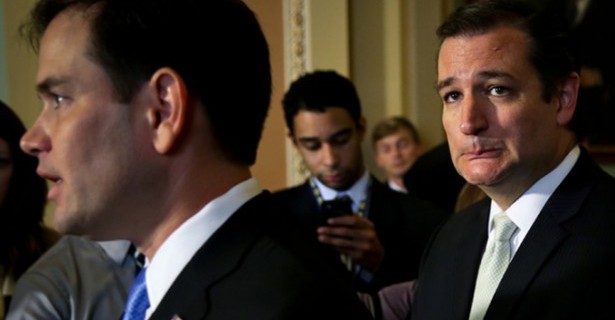
 Shutdown handmaidens Marco Rubio (L) and 
Ted Cruz (R) are both sons of Cuban exiles

Time was when US policy towards Cuba crossed the Party divide. There were always a good number of Democrats who supported the embargo policy and there were always a lot of Republicans who opposed it.  It may still be the case that some on each side differ on the issue, but my guess is that the matters is becoming more partisan, with the Demorcratic Party or at least this Democratic President becoming increasingly interested in easing aspects of the embargo and the Republican Party getting itself more and more entrenched in an pro-embargo 'let's crush Castro' position.
Why do I believe this? Well, first of all there was the meeting last Friday in Miami in which President Obama met with the now 'moderate' wing of the emigre community (as manisfested in the Cuban American National Foundation) and made the loudest noises yet that it is time for Cuba policy to evolve and adapt to the times. This blog by Arturo Lopez Levy explains how and why the President's words were significant in this regard. By calling the current US policy anachronistic, Obama is voiciung IN office what erstwhile Presidents and Secretaries of State have hitherto only dared to say AFTER vacating the White House.
This all makes for clear water between the President (and his Cuban-American Democratic supporters in Florida) and the the congressional Republican and Cuban-American right. The gulf has opened up since the showdown over Obamacare and the embarrassing stand-off that shut down the US government for weeks. Why? because it just happens that the two most fervent supporters of the Republican strategy to attack Obama on this issue were yes, you guessed it, Marco Rubio and Ted Cruz: two Cuban-American senators who as this blog highlights are deeply "embittered." It could be that these two have shot themselves in the foot.
How ironic it will be if it transpires that by trying to take a political dagger to Obama's heart on his health care plan, these two senators have hardened that heart enough for its owner to wish to exact a revenge...As Lopez Levy argues it is within the President's power as the executive to make huge changes to the embargo without having to have Congressional approval. Could we be about to witness the long overdue change in US Cuba policy that we have been waiting for?

Friday, 8 November 2013

Brazil is adding 3,000 Cuban doctors this week to the 2,400 Cuban doctors already in the country since September under the Mais Médicos program, according to this article in The Cuba Standard.
This exceeds the previously announced number by 1,400; more Cuban doctors may be contracted to reach the ambitious goals of the program. Revenues for Cuba at the current level of staffing are estimated at $250 million per year.
In May, the Brazilian government announced it would contract 6,000 Cuban doctors, but it backtracked as local physicians joined a wave of street protests in summer. Then, the Brazilian health ministry and the Pan American Health Organization (PAHO) announced Aug. 21 to contract 4,000 Cuban doctors as a backbone for a fast-expanding medical program in needy regions of Brazil.
“As long as there are Brazilians without a doctor, we will continue to bring professionals into the program,” Health Minister Alexandre Padilha said in a communiqué Nov. 5. “Mais Médicos is a first step towards a major transformation of healthcare in the country.”
With the arrival of the additional Cuban doctors this week, the program will include 6,600 professionals, the health ministry said, adding that it wants Mais Médicos to grow to nearly 13,000 doctors by March 2014. The health ministry has had a hard time finding enough Brazilian doctors to fill the spots.
Brazil agreed to pay Cuba, via PAHO, $4,000 per doctor each month, of which the doctors will receive a part. The Cuban doctors are contracted collectively through the Cuban government for three-year terms, to fill “vacancies not chosen by Brazilian and foreign professionals” in individual recruitment efforts under Brazil’s Mais Médicos programme, a press release by Brazil’s health ministry said.
The PAHO-Brazil agreement is a major breakthrough for Cuban efforts to diversify its for-pay medical service exports. While service exports a decade ago surpassed tourism as Cuba’s largest hard-currency generator, by far most of the healthcare exports are under agreements with oil-rich Venezuela. More than 20,000 medical personnel from Cuba work in Venezuela, or in third countries under programs funded by Venezuela.
Just weeks after the Brazil agreement, Ecuador announced in September it would contract 1,000 Cuban doctors for $30 million a year. Nov. 15-18, a delegation from Trinidad and Tobago will be in Cuba to negotiate contracting “scores” of Cuban doctors and up to 135 nurses.
 Recently, Cuba has been expanding more limited medical service programs in South Africa, Saudi Arabia, Qatar, Portugal and Algeria. Norway and Brazil have funded medical relief efforts involving Cuban doctors in Haiti.