Total Pageviews

Friday, 6 February 2015

In the Museum of the Captain General


Havana, Cuba, 6 February, 2015

Today I went to place where every American visitor should go here in Havana if they entertain the idea that Obama’s policy will win them back this island. It is a place that in the 30 odd years I have been coming to Cuba, I had never been before. So there you go. There is always something new to be learned, to be seen and to be enlightened by.
The place I am talking about is easily found. It is on the well-beaten tourist track, in fact it is housed within one of the most visited buildings in the city, the magnificent (in the true sense of the word) 18th century palace of the Captain General in the Plaza de Armas. It was for a while the place from which the Americans held dominion over the island between 1898 and 1902. A huge, limestone baroque Xanadu, the mother of all colonial buildings complete with a wooden paved road outside so that the sound of horses would not to keep the Captain General and his wife awake at siesta time. Now it serves as a prosaic and ironic reminder that neither the Spanish nor the Americans hold power here. It is a museum to the history of the struggle for Cuba’s independence in the 19th century.
So here, today hang portraits of the great heroes: the founding father de Cespedes, the poet apostle Martí and of course the Bronze Titan, Maceo, so called because he was wounded more than 20 times and carried that much shrapnel in his body. All three died in battle.
However, among all these exhibits hangs one that carries a message that every American should know, for here in one of the rooms hang the first flags of Cuba. I am talking about the actual cloth objects. The very first flags, symbols of the new nation, or one should say that at the time of their creation, the nation that was being dreamed into being.
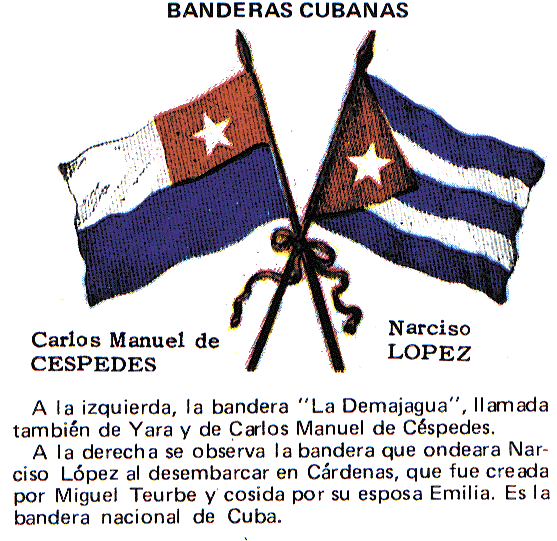
The first flag was de Cespedes’ flag, not the flag we see today that is familiar with its single white star on a red triangle and three blue stripes. De Cespedes’ flag is made up of three oblongs of red, white and blue and is similar to the flag of Texas. De Cespedes’ flag was that which flew above his troops in 1868 when the first war of Independence was launched. It was dropped in 1869 when the first Cuban republic was founded.
In the heat of the war that year, Cuba’s first representative assembly was held and the first republic declared and at that first assembly the gathered fighters adopted the flag we know today, but it was not a new flag then. It in fact dated back to 1850 and belonged, not to an independence fighter but to another type of rebel who at that time wanted to wrest the island from Spain.
A keen sense of irony is a necessary quality when viewing Cuban history, and here is a case in point. The flag that flies over Cuba’s parliament today, the flag of Fidel Castro, is in fact the flag of Narciso Lopez, a Venezuelan filibuster (a rather exotic word of Dutch origin that is essentially a synonym for a pirate) who tried twice in the 19th century to invade Cuba in order to have it annexed into the United States! And as if to make the irony even harder to bear, that flag was designed in New York.
The famous Cuban- American historian Louis Perez Jnr. Has a book entitled ‘Ties of singular intimacy’. You cannot find a more singular tie than the Cuban flag. As a symbol it just about captures it all. As I looked at it today and I thought about it, it made me smile. “Look” it says, “we want your inspiration, we want your republicanism, but we want it to be our own. To stand on our own feet, to choose our way freely and not to have it thrust upon us. We don’t want to be a part of you, we want to be as you are. Sovereign and free.”

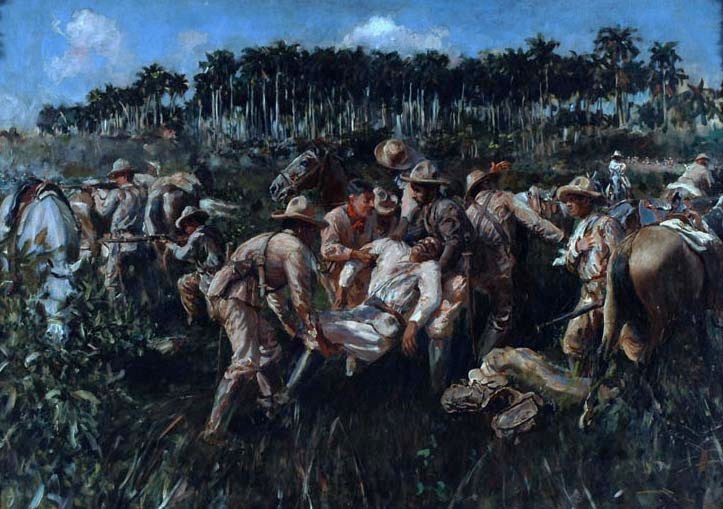
In the next room hangs an almost life sized painting of the Death of Maceo, a classical scene rendered expertly by Menocal in 1908.  After viewing Lopez’s flag, the North American visitor should contemplate what Maceo said: “He who tries to take over Cuba will reap nothing but its soil steeped in the blood of its people if they do not perish in the attempt.”

Tuesday, 23 December 2014

Cameron's silence on Cuba must be broken


From all corners of the globe the plaudits have come in for President Obama. He has been praised even by his enemies for his bold and magnanimous reversal of US policy towards Cuba. Even from within the island there is tremendous goodwill towards him. My colleague, Rafael Hernández , editor of the Havana magazine Temas, writing in today's Vanguardia newspaper in Havana says: "For the first time since Lincoln, an American President is popular in the island."

So one would have thought that Britain would have been first among those to applaud? But no. There has been a conspicuous silence from the UK and it is frankly shameful, not least because the UK is supposed to be the US's closest ally, but also because British banks have been among those most penalized most unfairly for carrying out transactions that are wholly within the law. One would have thought that HMG would be now seeking the kind of assurance that from now there will be no more victimization of our companies for dealing with Cuba. 

This letter from Lord Hutton of the Cuba Initiative in this morning's Financial Times makes the point most eloquently:   


December 22, 2014 11:42 pm

We trust UK banks will rethink their Cuba policy

Sir, The gradual normalisation of relations between the US and Cuba is to be wholeheartedly welcomed. The US embargo has not only prevented US companies from trading with Cuba but has been interpreted in such a way by the US Treasury as to have also become a significant impediment to UK companies as well.
The extraterritorial reach of US financial sanctions in particular, and the imposition of swingeing fines by the US on banks found to be in contravention of them, has meant that most British banks have been unwilling to handle UK banking transactions with Cuba in spite of the fact that under UK law they are perfectly legal and legitimate.
As the US moves to permit US institutions to hold correspondent accounts at Cuban financial institutions, and hopefully recognises that Cuba has no place on the list of state sponsors of terrorism, we trust that UK banks will rapidly reassess their policy towards supporting UK companies investing in and undertaking trade with Cuba.
The UK government has made abundantly clear that it supports engagement and increased investment and trade with Cuba. At the time of his visit last month to Havana, the Foreign Office minister Hugo Swire announced a major trade and investment mission of UK companies which I will be leading to Havana in the spring of 2015.At a time when the US is finally normalising its policy towards Cuba, it is vital that UK companies as well as banks rapidly engage so that the UK develops a strong position in Cuba and Britain’s economic interests in the region are upheld.
Lord Hutton of FurnessChairman, The Cuba Initiative


He might have added that it is vital for the UK government to bring this matter up with the White House while at the same time helping President Obama face down his enemies in Congress by giving fulsome praise for his sensible and grown up policy on Cuba.

Why is Cameron silent? Well it might possibly have something to do with the Malvinas issue with Argentina. He is facing calls to copy Obama's policy and sit down an talk about the UK's differences with Argentina. Perhaps here is an opportunity for Mr Miliband to show his mettle?

Saturday, 20 December 2014

Should Cuba be on the US terror list?


One of the key policy changes announced by President Obama on 17 November was the instruction to Secretary of State John Kerry to report within six months on whether Cuba should be listed among the states that support terrorism.
The designation of Cuba as a state sponsor of terrorism has been a contentious issue from the start. The fact that Cuba has been a victim of terrorism itself and ironically from the United States, has meant that this has been a source of deep resentment in Havana. However, the hurt is more than moral. Economically too, the inclusion of Cuba on  the so-called ‘terror list’ has meant that foreign banks have been severely fined in the US for dealing with the island to the extent that they have pulled out of dealing with Cuba altogether. This has added enormously to the financial burden placed on the Cuban economy.
Thus, removing Cuba from the list would not only heal an emotional wound it would help Cuba’s economy to grow. So should Cuba be on the list? The evidence suggests that it should clearly not.

Here from USAToday is a very good explanation as to why.

Thursday, 18 December 2014

The SS Embargo is holed beneath the waterline


It was a truly historic moment: The day President Obama finally deserved that Nobel Peace Prize. By making his announcement yesterday, he has put himself into the history books as the President who finally had the cojones to free the White House from the grip of that Miami crazy gang.

The crazy gang are correct in one thing and one thing only, Obama's unilateral move yesterday did provide the Cuban government with a victory. Essentially, the Cuban government only released a few prisoners, but the United States admitted that its policy towards the country for the last 53 years was a failure. For that Obama deserves huge praise. To err is human but to admit one's errors is truly divine. Obama has not only moved US policy on Cuba, he has moved United States diplomacy onto a whole new plane. Americans should rejoice that they have a leader with such a vision.

Obama has used the Presidential prerogative to make foreign policy in the national interest and by making significant changes in the way that companies and individuals will be able to engage with Cuba, and more importantly send money, visit and do business with the island, he has delivered a death blow to the whole embargo.

The best analogy was used some time ago by my colleague, Professor Phillip Brenner of American University. He said that you have to think of the embargo as ship which has holes in it. The holes are exceptions such the permission for US farmers to export food or the right of Cuban Americans to visit etc. The proponents of the embargo are like the crew keeping the ship afloat by busily blocking up holes or stopping them from getting bigger. Well, Obama's announcement yesterday just made so many holes in the ship that they will find it impossible to stop the leaks.

The SS embargo is holed below the waterline and will soon sink into beneath waves of history.

You read it here first...

Friday, 5 September 2014

Public Event: Discovering Places: Cuba

http://cubastudies.org/wp-content/uploads/2014/08/8692406075_ca2c3383ab_n.jpg

Wednesday 15 October, 6.30pm-9.00pm 

Discovering Places: Cuba

Royal Geographical Society
1 Kensington Gore,
London, SW7 2AR.


An informative evening for those planning their first trip to Cuba. Network with exhibitors, share plans with fellow travellers and ask questions of our expert panellists: travel writer, photographer, guidebook author and Cubaphile Claire Boobbyer; and lecturer on Cuban literature and society and chairman of the International Institute for the Study of Cuba Dr Stephen Wilkinson.
Our panel and exhibitors will share their experiences, travel inspiration, practical advice and up-to-date knowledge of Cuba.
  • Kensington Gore doors open at 6.30pm, wine is served and attendees may browse exhibitor tables
  • Presentations and discussion will start at 7.00pm, followed by further networking/exhibitors at 8.15pm
  • Event ends at 9.00pm
  • Admittance is by ticket only
email events@rgs.org
Tickets: RGS-IBG members £10, non-members £15.
(you will be taken to the sign in/registration page of the website)
telephone+44 (0)20 7591 3100
About the panel:
Claire Boobbyer is a freelance travel writer, editor, photographer and Cubaphile who first arrived in Havana in 1998. Claire leads tours, writes about Cuba for the national press and contributes to a dozen travel guides to the island, including 2013 publications Rough Guide Cuba and DK’s Eyewitness Cuba.
Dr Stephen Wilkinson first visited Cuba in 1986 and has been travelling to and writing about the island ever since. Stephen is Chairman of the International Institute for the Study of Cuba and Editor of the International Journal of Cuban Studies, he consults on a variety of media projects related to the island and leads tours for academic study groups and exchanges. Stephen lectures on Cuban literature, is author of Detective fiction in Cuban society and culture and has written numerous articles about Cuban society.

Monday, 4 August 2014

Another fine mess they got them into...


The Associated Press has just published the results of an investigation that finds President Barack Obama's administration secretly sent young Latin Americans to Cuba under the cover of health programs to try and provoke a political uprising.

Internal documents obtained by the AP and interviews in six countries found that the travellers worked undercover for a U.S. Agency for International Development programme.
They posed as tourists in Cuba and looked for young Cubans who could become political activists.

Saturday, 21 June 2014

Cuban-Americans want change


Florida International University released a new poll on Tuesday 17 June, that surveyed how Cuban Americans in Miami view U.S. policies towards Cuba. Over the past few years  poll after poll has shown how the opinion of the majority of Cuban Americans has chnaged to now favouring engagement with the Cuban government and a change in U.S. policy. However, FIU’s latest poll is the most impressive yet. It shows a clear shift among younger Cuban Americans, aged 18-29, who present an even larger majority in favour of engagement and U.S. policy change towards Cuba.

It is ever clearer in Miami, the hub of the Cuban-American community, that U.S. policy towards Cuba ino longer reflects the majority of Cuban-Americans' opinion, nor the majority opinion of all U.S. citizens. Here are the results:

•    52 percent of all Cuban-American respondents oppose the continuation of the embargo; the percentage rises to 62 percent of Cuban Americans ages 18-29 who oppose the embargo.
•    68 percent of all Cuban-American respondents and 90 percent of younger Cuban Americans favor diplomatic relations with Cuba.
•    69 percent of all respondents and 89 percent of younger Cuban Americans favor the lifting of travel restrictions that limit all U.S. citizens from traveling to Cuba.
•    71 percent of all respondents support the continuation of “people-to-people” travel opportunities.
•    53 percent of all registered voters surveyed and 75 percent of younger Cuban Americans who are registered to vote responded that they would be very likely or somewhat likely to vote for a candidate for political office who supported the reestablishment of diplomatic relations with Cuba.

Proponents of the embargo in Congress who claim to represent the majority of Cuban Americans, and even more specifically, Cuban Americans from Miami, clearly no longer do so.
It is going to be very interesting to see how these polls translate into real votes in the November gubernatorial and mid-term federal elections.

If you are a U.S. citizen you can influence your Congressman by clicking on the link below:

Send an email to your members of Congress and tell them that now is the time to engage with Cuba!