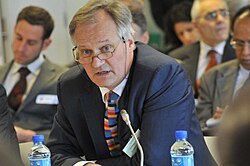
I have just returned from the Conference of the Latin American Studies
Association (LASA) held at the Marriot Wardman Hotel in Washington DC, May 30-June 1.
Here below is a paper presrented at Panel 343 - Cuba and the United States:
What will take to normalize relations between the two countries; Global
ramifications
United States-Cuba Relations: 7 Myths and
5 Facts
In the
post reelection of President Barack Obama, several
theories have been formulated on
whether there is a shift
regarding U.S. bilateral policy toward Cuba. If that were the case, in
the process of decision making, consultants and politicians have to deal not only with real facts, but also with myths that have been repeated for years in the imagery of the American press and some
domestic political science of poor quality. We will refer to some of them (myths and
facts), which are not the only
ones and are not ranked in order of
importance. I will mention each
of them followed by our comments:
Myths:
1. U.S. relations with Cuba are a domestic issue
for the United States instead of a foreign
policy one.
Considering how the
U.S foreign policy is formulated, almost all issues of its foreign policy are
related to domestic policy: it
was necessary to "convince" the American people of the
"threat" posed by terrorism before pushing the country toward a permanent war against an invisible enemy
in the Middle East. Notwithstanding, quotations from any of the U.S. presidents during
the nineteenth-century may prove that the U.S. policy to try to take possession of Cuba dates back to years before the triumph of the revolutionary project in January 1959
and, of course, even before larger
groups of immigrants settled in South Florida. We cannot ignore the fact that certain refinement
in politics, better structure and financing of some of these groups enabled them to better insert in the
decision making process of the United States, but this was never
a decisive factor and, by no means, they
were a defining element in the
presidential elections. A simple fact: the Cuban extreme right-wing of South Florida could never
impose the Republican vote in any of the three main counties where it has settled, namely Monroe, Miami-Dade, Broward.
2. Fostering U.S.–Cuban economic relations
cannot be possible until the nationalization issue is solved.
As
known, the process of nationalization in Cuba during the 60s of last century
took place based on Act 851, which was passed by the revolutionary government
to that effect. This instrument provided for the use of compensation on the
same terms established by the International Law. In fact, the Cuban authorities
were able to reach agreements on compensation which favored the interests of
several countries that were representing their citizens, whose properties in
Cuba were nationalized. There are no claims pending in the cases of Spain,
France, Italy, and others. Cuban law provided for the compensation for the
interests of U.S. companies by using the country's income from the sale of
sugar in the U.S. market, which was part of the benefits of the sugar quota
allocated to our country. Unfortunately, one of the first reactions from
Washington to the process of nationalization in Cuba was the suspension of the
quota, which made it impossible for compensation. However, for years the U.S.
federal agencies exempted companies and persons included in the list of
"claimants" from paying taxes for the same value of the claim; so they
already received their compensation. More recently, some of the main
"claimants" have passed away or don´t exist anymore as natural or
legal persons and others have stated that they are not longer interested in the
subject. On the other hand, it must not be forgotten that in a scenario of
possible bilateral negotiations, Cuba has also updated its figures on the human
and material damage caused by the blockade and other hostile polices imposed by
the United States.
3. Exercising pressure will bring about
changes and ultimately the Helms-Burton Act (LHB in Spanish) and in general the
blockade policy will lead to changes in Cuba.
This law and all
the anti-Cuba plans that preceded it have been probably the greatest economic
and political fiasco in the history of U.S. foreign policy. Given the enormous
amount of resources allocated to destroy Cuba, one might ask: what is the
tangible result U.S. political classes have obtained in return? The Chamber of
Commerce of the United States has estimated that the annual cost of the
blockade against Cuba represents a loss to the U.S. economy in the order of 1.2
to 3,600,000,000 dollars. They have tried everything against Cuba: from using
military force, encouraging mass migration until bacteriological warfare and
hiring mercenaries. No country in the history of humanity has grown and
developed its society as Cuba, which has been under the attack of, or at least without
maintaining relations with the first economic and military power of any era.
Cuba is still a Third World country with economic difficulties, but also with
an extraordinary ability to share the little it has and not what it has left.
The premises on which the LHB is based, and its most recent interpretation
encompassed in the "change of regime" programs, are the very negation
of any system of nations and of the respect for the rights of others to ensure
peace.
4. It is impossible to promote bilateral
relations between Cuba and the
United States due to the
existence of specific obstacles.
Cuba has reiterated its willingness to discuss and reach an agreement on a variety of topics, without preconditions and by observing a relationship between sovereign equal parties.
Recently, the argument
set forth by the U.S. for not moving forward has been the trial and conviction of a USAID "contractor" in Cuba. Those who
have spent years studying U.S.-Cuba bilateral
relations may recall arguments
such as Cuba's relations with the USSR, the Soviet
military presence in Cuba, Cuba´s
support to national liberation
movements, the Cuban military presence in Africa, the alleged violation of
human rights and
many other arguments. In pre-revolutionary
Cuba, while dealing with issues of bilateral relations with Cuba, there
were annoying factors like the ones that exist today between the U.S. and a number of countries that
have built a different social system, have a
different interpretation of democracy or of the political participation of its citizens and business practices.
In none of these cases, these differences have led Washington to establish a policy of blockade or even think about breaking
off bilateral relations. The foreign policy of a country is not defined by some details and differences, but by principles (or lack of them) and by
the political will.
5. We have to wait until the historic
generation of the Revolution disappears because younger generations have
different values.
Gerardo Hernandez, Fernando Gonzalez, Antonio
Guerrero, Ramón Labañino and Rene Gonzalez, more commonly known as the Cuban
Five, have accumulated 15 years of an unprecedented experience in U.S. jails
and courts. Some federal agencies have studied their behavior and do not
understand how these men have been willing to give part of their youth and
their lives for the love of their people, the country that is waiting for them.
That is because of the respect they have for their profound convictions. They
are undoubtedly exceptional people, but at the same time are just an example of
the new generations of Cubans who have had the opportunity to be men and women
of decency thanks to the Revolution, of those who know that you can endure hunger
but not dishonor. Today the average age of the National Assembly of Cuba is 49
years, similar to the average age of the Council of Ministers and of the
governors of the provinces.
6. Cuba is isolated and in desperate need of foreign
economic partners.
Cuba has diplomatic relations with 190
member countries of the UN system. One hundred and six countries and
international organizations are represented in Havana. The main scene of the
failure of the policy of isolation against Cuba is precisely Latin America and
the Caribbean. That region has undergone a profound transformation process and
has traveled in time from the unfortunate exclusion of Cuba from the OAS in
1963, until the election of Cuba as president of the Community of Latin
American States in 2013. Meanwhile, Cuba has been elected twice president of
the Non-Aligned Movement, member of the United Nations Security Council, the United Nations Economic and Social Council
(ECOSOC) and countless bodies of
the United Nations system. In no multilateral issue Cuba has received a
contrary vote by any of the 188 member countries of the United Nations system
as the United States does receive during the voting against the blockade. Cuba is
building a sustainable economic system, oriented to services and value-added
production, benefiting from the performance of the major investment of all
these years: human talent. Cuba has mentioned on several occasions the
complementary value of foreign investment for the country's economy, while
recognizing the importance of its contribution in various sectors, but is not
building its future depending on favor by foreign capital.
7. For 30 years Cuba has sponsored terrorism.
In 1982
under the administration of Ronald Reagan, Cuba was included in the spurious
mechanism of the list of states sponsors of terrorism. The main reasons given
then were the support given to the Sandinistas in Nicaragua, the party in power
today, the support to the FMLN (in Spanish) in El Salvador, which is in power
today, besides the support to other liberation forces who came to arms when all
peaceful alternatives failed, such as the inhabitants of New England did in the
18th century against the English power. At their convenience, U.S.
officials have also referred to the presence in Cuba of FLQ and ETA militants,
who traveled to our country at the request of the governments of Canada and
Spain, respectively, and have remained there under their supervision. Likewise,
they have mentioned the presence of Colombian guerrilla fighters in the island.
The latest developments surrounding the Colombian peace process relieves me of
giving more explanations. It must be added Cuba's adherence to the main
international instruments against terrorism and the timely cooperation with
U.S. authorities in this regard, as the willingness shown by the Cuban
government on September 11, 2011, when it offered the airspace and airports of
the island to U.S. airlines so that they could use them.
Facts:
1. Cuba is not a priority in U.S. foreign policy agenda.
According to the statements by key U.S. executives, the strategic concerns
of the country are related to the evolution of China and
Russia and the endless wars that are
taking place in the Middle East.
In Latin America, in a scenery of post-neoliberalism and free-trade agreements,
the United States has not been able to coordinate
regional policies, or even understand the
origins of the social processes taking
place in the region nor the
extent of them. The OAS is
becoming a bureaucracy that exists
to defend their self-preservation,
and mechanisms such as the Union of South American Nations
(UNASUR in Spanish), the Southern Cone Common Market (MERCOSUR in Spanish), the Bolivarian Alliance for the Americas
(ALBA in Spanish), the Central American Integration System (SICA in Spanish), the
Caribbean Community (CARICOM) and
the Community of Latin American and
Caribbean States (CELAC in Spanish) offer alternatives linked to the interests of the Latin American and Caribbean countries. In this context, the Cuban market does not and will not have the potential to be
a significant partner for the U.S.
economy. However, we cannot rule
out the importance the Cuban market has for
certain sectors and geographical areas of the U.S. economy. In the last 10 years, for purchases made under license in the U.S., Cuba has paid 5 billion
dollars in cash, without
the benefits of the credit and without
using its own merchant
fleet. The day we will resume
bilateral trade relations, the exchange
will be in both directions because Cuba has
services and products in spheres such as
healthcare, education and information
technology, just to name a few, which compete
with the standards of more developed
economies and are considered unique
at the global level.
2. There is a historical and ethical need for
the United States to break the bonds of the dirty war against Cuba.
Since
1959, successive Republican administrations have had a direct relationship, and
in some cases personal, with major terrorist plots against Cuba and its
leaders. Successive Democratic administrations to date inherited and continued
to carry out these plans or simply were victims of blackmail and were incapable
of controlling the main actors of the Cuban counterrevolution. The Obama
administration has no links with the horde that at some point made the war
against Cuba its cause, in which there are no ethics or principles, or made
it their way of life at the expense of the federal budget of the United
States. A new generation of U.S. politicians is in a unique position of being
able to turn the page and leave behind commitments and methods on how to make
foreign policy, which are the negation of the values they claim to defend when
it comes to domestic policy.
3. The Obama administration will leave office
with no legacy in foreign policy.
During the eight years of George
Bush administration, the so-called War on Terror embroiled the U.S. in endless
conflicts, reduced their economic capacity to meet the challenges of emerging
powers and caused a significant political damage in respect to its allies. The
Obama administration has not even remotely met its election promises regarding
the conflicts in the Middle East, and it constitutes a paradigmatic fact its
inability to close the concentration camp established at Guantanamo Bay, where
the greatest amount of human rights violations are taking place per square
centimeter. A different perspective on Cuba and, with it, the possibility of establishing
a new kind of relationship with a new Latin America and Caribbean will make
possible that Barack Obama withdraws to Chicago or his native Hawaii with something
else than a library with his name.
4. Several national security issues cannot be faced
by the United States without cooperating with Cuba.
In
January 2010, Cuba submitted to U.S. authorities a draft agreement to jointly
combat Drug Trafficking. In June of the same year, a similar proposal was
submitted for an Environment and Natural
Disaster Prevention. In February 2012, Cuba handed in a proposal with a program to
Fight Terrorism. These are just three areas that due to the
geographical position of both countries and the accumulated experience, it is
feasible and necessary that specialists and agencies from both countries share
information and resources. When the United States regards health and education
of its citizens as national security issues, unlimited areas of cooperation
with Cuba will emerge.
5. A country that claims to be a democratic
system cannot turn its back to the will of its people.
For years,
the biggest U.S. pollsters have consistently provided figures ranging between
60 and 70% of the samples that favor a change in policy toward Cuba. A similar
majority has publicly expressed that the policy of the economic blockade and
political isolation has failed. A bigger number has spoken out against limiting
the rights of the average U.S. citizen to travel to the island. Among Cuban-Americans,
particularly since 1990, a vast majority has favored the normalization of
relations with their country of origin and, especially, the development of what
has been called the family agenda, which includes visits to and from the
island, exchange of remittances and goods, postal mail, telephone service. How
is it then that a small group of lawmakers hamper once and again the adoption
of measures to respond to this claim and, furthermore, use McCarthyist
techniques to frighten mid-level officials who always fear that their
promotions are not approved? Certainly, doubt remains about the alleged
American exceptionalism when it comes to the formulation of a policy toward
Cuba.